NPS
Code
library(tidyverse)

theme_set(theme_minimal())

color_primary <- "#2171b5"
color_secondary <- "#888888"
color_reference <- "gray50"

set.seed(42)
The population
We start with a synthetic population of 10,000 people whose self-reported happiness follows a roughly normal distribution. We set the true mean to 7.7, matching the 2025 figure reported by Statistics Netherlands.
N <- 10000

population <- tibble(
  id        = 1:N,
  happiness = rnorm(N, mean = 7.7, sd = 1.5)
)

pop_mean <- mean(population$happiness)

ggplot(population, aes(x = happiness)) +
  geom_histogram(bins = 60, fill = "steelblue", alpha = 0.8) +
  geom_vline(xintercept = pop_mean, color = "red", linewidth = 1) +
  labs(
    title = "Population happiness distribution",
    subtitle = paste0("True mean = ", round(pop_mean, 2)),
    x = "Happiness (0–10)", y = "Count"
  )
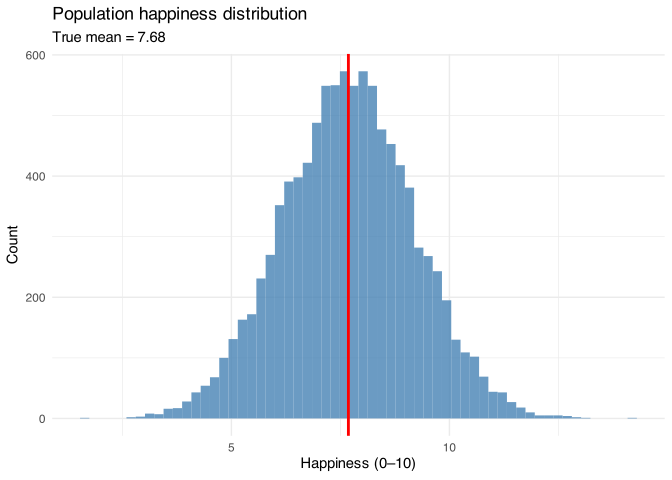
The red line marks the true population mean — the quantity we want to estimate from a sample.
Simple random sampling is unbiased
With simple random sampling (SRS), every person has an equal probability of being selected. To see what this means in practice, we draw 1,000 independent samples of size and record the sample mean each time.
n    <- 200
sims <- 1000

estimates_srs <- replicate(sims, {
  population |> slice_sample(n = n) |> pull(happiness) |> mean()
})

tibble(estimate = estimates_srs) |>
  ggplot(aes(x = estimate)) +
  geom_histogram(bins = 50, fill = "steelblue", alpha = 0.8) +
  geom_vline(xintercept = pop_mean, color = "red", linewidth = 1) +
  labs(
    title = "Sampling distribution under simple random sampling",
    subtitle = paste0("n = ", n, ", ", sims, " simulations | Red line = true population mean"),
    x = "Sample mean happiness", y = "Count"
  )

The distribution of estimates is centred on the true mean. Individual samples vary — some overestimate, some underestimate — but there is no systematic bias. This is the defining property of probability sampling.
Non-probability sampling introduces bias
Now suppose we can’t draw a random sample. Instead, people self-select into our dataset. Happier people are more inclined to share their feelings; unhappier people tend to opt out.
We parameterise the selection mechanism directly in terms of something interpretable: the mean happiness difference between people who self-select in and those who don’t. Setting delta_selection = 0.5 means that participants are on average 0.5 happiness points happier than the general population — a moderate but realistic self-selection effect.
delta_selection <- 0.5  # participants are this many points happier on average

population <- population |>
  mutate(
    # Exponential tilt: k = delta/var(Y) gives the desired mean difference in expectation
    p_select = exp(delta_selection / var(happiness) * happiness)
  )
In concrete terms, this selection mechanism means three equivalent things:
- Mean difference: participants are on average 0.5 happiness points happier than non-participants
- Relative likelihood: each additional happiness point makes someone 25% more likely to self-select — so someone scoring 8 is 1.6× as likely to end up in the dataset as someone scoring 6
- Data defect correlation: = 0.047 — a number we will return to shortly
estimates_nonprob <- replicate(sims, {
  population |>
    slice_sample(n = n, weight_by = p_select) |>
    pull(happiness) |>
    mean()
})

bind_rows(
  tibble(estimate = estimates_srs,     method = "Simple random sample"),
  tibble(estimate = estimates_nonprob, method = "Non-probability sample")
) |>
  ggplot(aes(x = estimate, fill = method)) +
  geom_histogram(bins = 50, alpha = 0.7, position = "identity") +
  geom_vline(xintercept = pop_mean, color = "red", linewidth = 1) +
  scale_fill_manual(values = c("steelblue", "darkorange")) +
  labs(
    title = "SRS vs non-probability sampling",
    subtitle = "Red line = true population mean",
    x = "Sample mean happiness", y = "Count", fill = NULL
  ) +
  theme(legend.position = "top")
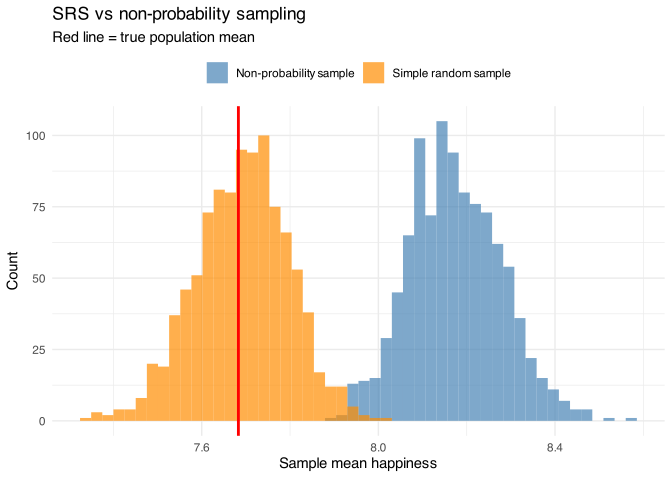
The non-probability sample consistently overestimates happiness: people who report higher happiness are more likely to participate, so the sample is no longer a mirror of the population. Crucially, a larger non-probability sample doesn’t fix this — it just gives you a more precise estimate of the wrong number.
This is the core problem that Meng’s (2018) data defect index quantifies.
The data defect index
Meng (2018) shows that the expected error of a sample mean decomposes into three factors:
where is the correlation between the selection indicator (1 if person is in the sample, 0 otherwise) and the outcome (happiness). For a probability sample, by design — everyone has the same chance of being selected, so selection and outcome are uncorrelated. For a self-selected sample, , and that alone is enough to produce bias regardless of sample size.
The data defect index is : the share of variance in happiness that is explained by whether someone ended up in the sample.
We can compute directly from our simulated population:
sigma_Y <- sd(population$happiness)

# rho_{R,Y} is the correlation between the *binary* selection indicator
# (1 = in sample, 0 = not) and happiness — not the continuous selection weight.
# We average over many draws to get a stable estimate.
rho_RY <- mean(replicate(200, {
  R <- as.integer(seq_len(N) %in% sample(N, n, prob = population$p_select))
  cor(R, population$happiness)
}))

cat("rho_{R,Y} =", round(rho_RY, 3), "\n")
rho_{R,Y} = 0.048
cat("DDI =", round(rho_RY^2, 4), "\n")
DDI = 0.0023
And check that the formula predicts the observed bias:
predicted_bias <- rho_RY * sqrt((N - n) / n) * sigma_Y
observed_bias  <- mean(estimates_nonprob) - pop_mean

cat("Predicted bias:", round(predicted_bias, 3), "\n")
Predicted bias: 0.506
cat("Observed bias: ", round(observed_bias, 3), "\n")
Observed bias: 0.491
Which should you trust more: a probability survey or a large non-probability dataset?
Now let’s make this concrete using realistic Dutch figures. Statistics Netherlands measures happiness using a survey of around 7,500 respondents. A realistic alternative might be a large online panel — the Netherlands has several with 100K–500K members. We use 500K as an upper bound for a well-resourced panel.
N_NL <- 17900000  # Netherlands population
n_A  <- 7500      # CBS survey
n_B  <- 500000    # large online panel
Both surveys are affected by a data defect. For Survey A, it is non-response: not everyone who is sampled agrees to participate, and unhappier people may be less likely to respond. For Survey B, it is self-selection: happier people are more likely to join and stay in a panel. Since means the same thing in both cases — correlation between selection and outcome — we can compare them on the same axis.
The data quantity multipliers are very different: is 48.8 for Survey A and 5.9 for Survey B. Any given hits Survey A roughly 8 times harder.
The plausible ranges for look very different in magnitude — 0.001–0.005 for Survey A vs 0.03–0.10 for Survey B — but this is partly a mathematical artefact. Because Survey A selects only 0.04% of the population, its selection indicator is a very sparse binary variable with low variance, which mechanically compresses toward zero. A more intuitive quantity is the implied mean happiness difference between included and excluded people:
| Survey | Δ at ρ_low | Δ at ρ_high |
|---|---|---|
| Survey A (CBS) | 0.07 | 0.37 |
| Panel, n = 10,000 | 1.92 | 6.39 |
| Panel, n = 50,000 | 0.86 | 2.86 |
| Panel, n = 100,000 | 0.61 | 2.02 |
| Panel, n = 500,000 | 0.27 | 0.92 |
Implied mean difference (happiness points) between included and excluded people
Survey A’s plausible range maps to a responder/non-responder difference of roughly 0.1–0.4 happiness points — a reasonable assumption for a well-designed survey with follow-up. Panel surveys’ larger values similarly map to plausible self-selection gaps of 0.3–1+ points, consistent with what validation studies find when comparing panels to probability benchmarks.
mult_A  <- sqrt((N_NL - n_A) / n_A)
n_B_vec <- c(10000, 50000, 100000, 500000)

rmse <- function(rho, mult, n) sqrt((rho * mult * sigma_Y)^2 + sigma_Y^2 / n)

bind_rows(
  tibble(
    label   = "Survey A\n(CBS, n = 7,500)",
    rmse_lo = rmse(rho_A_plausible[1], mult_A, n_A),
    rmse_hi = rmse(rho_A_plausible[2], mult_A, n_A),
    type    = "A"
  ),
  tibble(
    n_B     = n_B_vec,
    label   = paste0("Panel\nn = ", scales::comma(n_B_vec)),
    rmse_lo = rmse(rho_B_plausible[1], sqrt((N_NL - n_B_vec) / n_B_vec), n_B_vec),
    rmse_hi = rmse(rho_B_plausible[2], sqrt((N_NL - n_B_vec) / n_B_vec), n_B_vec),
    type    = "B"
  )
) |>
  mutate(label = fct_inorder(label)) |>
  ggplot(aes(x = label, color = type)) +
  geom_linerange(aes(ymin = rmse_lo, ymax = rmse_hi), linewidth = 3, alpha = 0.6) +
  geom_point(aes(y = rmse_lo), size = 2) +
  geom_point(aes(y = rmse_hi), size = 2) +
  scale_color_manual(values = c("A" = "steelblue", "B" = "darkorange"), guide = "none") +
  scale_y_log10() +
  labs(
    title = "Expected error at plausible data defect ranges",
    subtitle = "Ranges reflect ρ_A ∈ [0.001, 0.005] and ρ_B ∈ [0.03, 0.10]",
    x = NULL,
    y = "Expected error / RMSE (log scale)"
  )
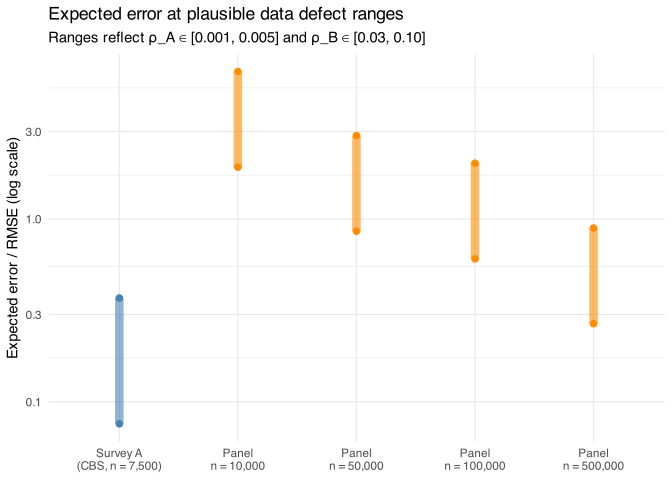
The intervals show the plausible RMSE range for each approach given realistic data defect correlations. Survey A performs well — its small sample is compensated by a much tighter data defect. Panel surveys only become competitive at very large sizes (500K+) and only if their self-selection bias stays near the lower end of the plausible range, where the intervals just start to overlap.
The plot is therefore best read as a sensitivity analysis: it tells you what would need to be for each survey to win, and whether those values are plausible is a subject-matter judgement. Estimating from the data alone is generally not possible — you can only observe the people who ended up in your sample. Two approaches can provide empirical grounding: follow-up studies, where a random subsample of non-responders is intensively pursued and their responses compared to those of responders; and benchmarking against a probability sample, where the two estimates are compared to back out an implied for the non-probability dataset. Neither gives a complete answer, but both constrain the plausible range.